
 Jeff Daley Books
The Early Years of Army Special Forces
From a new organization at Fort Bragg to teams serving overseas, the 1950s turned wartime experience into a lasting unconventional warfare capability.
Army Special Forces grew from the effort to give unconventional warfare a permanent place in the postwar Army. The Korean War made the need urgent. Wartime experience in resistance, guerrilla operations, and service behind enemy lines had to be turned into an organization that could recruit, train, and deploy soldiers for those missions.
This chapter follows the subjects of my original “The Early Years” article: the first Special Forces group, its training mission, service in Korea, and the detachments that extended Special Forces into the Pacific.
A foundation for unconventional warfare
The Army’s psychological warfare establishment provided the institutional foundation for Special Forces. Brigadier General Robert A. McClure brought together officers with unconventional warfare experience, including Aaron Bank, Russell Volckmann, and Wendell Fertig. Their task was to convert lessons from World War II into an enduring military capability.1
The disbandment of the Korean War Ranger companies helped make personnel spaces available for the new organization. Special Forces was being built for a different purpose: to enter enemy-held territory and organize, train, and support resistance forces.2
Colonel Bank and the 10th Group
Colonel Aaron Bank became the first commander of the 10th Special Forces Group at Fort Bragg, North Carolina. Its headquarters company was activated in May 1952; the remainder of the group followed in June. Bank assembled officers and noncommissioned officers who could form a cadre and teach the volunteers who followed.2
He sought experienced soldiers. Former OSS personnel, airborne troops, former Rangers, and combat veterans brought skills that could be adapted to unfamiliar assignments. The organization began small, then grew as volunteers completed their initial preparation.
Training for a different mission
The new group’s mission demanded more than proficiency in a single military specialty. Soldiers had to prepare to infiltrate by land, sea, or air and work with resistance forces deep in enemy-held territory. Teaching, planning, communications, and the ability to operate with limited supervision were essential.2
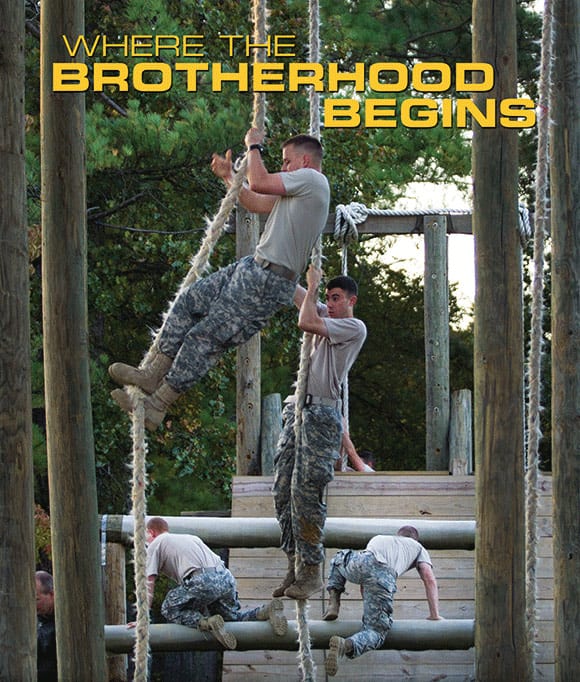
The photograph illustrates a continuing requirement: individual skill must serve the team. Early Special Forces training established the foundation for soldiers who would have to train others as well as carry out their own tasks.
Germany and the 77th Group
In 1953, the 10th Special Forces Group deployed to Bad Tölz, West Germany. Personnel who remained at Fort Bragg formed the cadre for the 77th Special Forces Group. The division gave the Army both an overseas unconventional warfare force and a continuing organization in the United States.2
The European mission reflected the Cold War threat. Special Forces prepared for the possibility of organizing resistance behind Soviet lines. Meanwhile, its soldiers were also gaining operational experience elsewhere.
Korea and the Donkeys and Wolfpacks
Anti-communist North Korean partisans operated from islands off the Korean Peninsula. American advisers helped organize and support these forces, whose organizations included the DONKEYS and WOLFPACKS. Soldiers from the 10th Special Forces Group joined the advisory effort and participated in unconventional warfare operations.7
The partisan campaign included mainland raids and intelligence activity. It required maritime movement, resupply, training, and coordination among several military and intelligence organizations. The 8240th Army Unit was central to the Army’s employment of the partisans.
This was the first combat employment of the newly established Army Special Forces. It also demonstrated the complications of working with local forces when different commands and agencies shared an interest in the same operating area.7
The early Pacific detachments
In 1956, the Army formed regionally oriented detachments for the Pacific. The 14th Special Forces Operational Detachment was organized at Fort Bragg and sent to Hawaii. It used the cover designation 8251st Army Unit. The 12th, 13th, and 16th detachments in Japan were associated with the 8231st Army Unit designation.8
These were small organizations with large responsibilities: preparing to support resistance and train allied forces across a wide region. Their establishment marked a widening of Special Forces’ attention beyond Europe.
The 1st Special Forces Group was activated at Camp Drake, Japan, on June 24, 1957, and moved to Okinawa in July. Its mobile training teams worked with partner forces in Asia. A small Special Forces detachment also began training South Vietnamese soldiers in Ranger tactics and techniques in 1957.45
The school behind the training
The original article also described the training institution that became the U.S. Army John F. Kennedy Special Warfare Center and School. Its early history is tied to the Psychological Warfare Center and School at Fort Bragg.2
The original photograph and its Army credit are preserved above. The older article’s student totals and course counts described the school at that time; they are not presented here as current figures.
These early years established the organization, training base, and overseas experience from which later Special Forces operations grew. They also lead naturally to the next question: why did Special Forces organize around twelve-man teams?
Walking in the Garden
Follow the history into a firsthand account of long-range reconnaissance in Vietnam’s Central Highlands, written by veteran Jeff Daley.
Explore the memoir Find a booksellerSource
References for Chapter 2. Organizational histories sometimes distinguish headquarters activation from the activation of the remainder of a unit; the text reflects that distinction.
- U.S. Army, Becoming Special Forces.
- Eugene G. Piasecki, USASOC History Office, The Psywar Center: Creation of the 10th Special Forces Group; A Timeline of U.S. Army Special Operations Forces; U.S. Army, 10th Special Forces Group History.
- Eugene G. Piasecki, USASOC History Office, Training the Trainers: Donald D. Blackburn and the 77th Special Forces Group.
- USASOC History Office, 1st Special Forces Group Lineage and Honors and Veritas historical roundup, 1st Special Forces Group activation and mobile training teams.
- USASOC History Office, A Team Effort: Special Forces in Vietnam, June–December 1964.
- Kenneth Finlayson, USASOC History Office, Wolfpacks and Donkeys: Special Forces Soldiers in the Korean War.
- USASOC History Office, Special Forces Detachment 39 and Sine Pari: The Story of Army Special Operations.
- Original text and training image: Jeff Daley, Special Forces Part 2 — The Early Years, originally published July 2, 2015. Training image credited there to SOC.MIL/SWCS — U.S. Army.