
 Jeff Daley Books
The Constitution of the United States
Its History and Evolution
Founding principles, the struggle over slavery, and the continuing debate over the limits of government.
Explore the twelve chapters ↓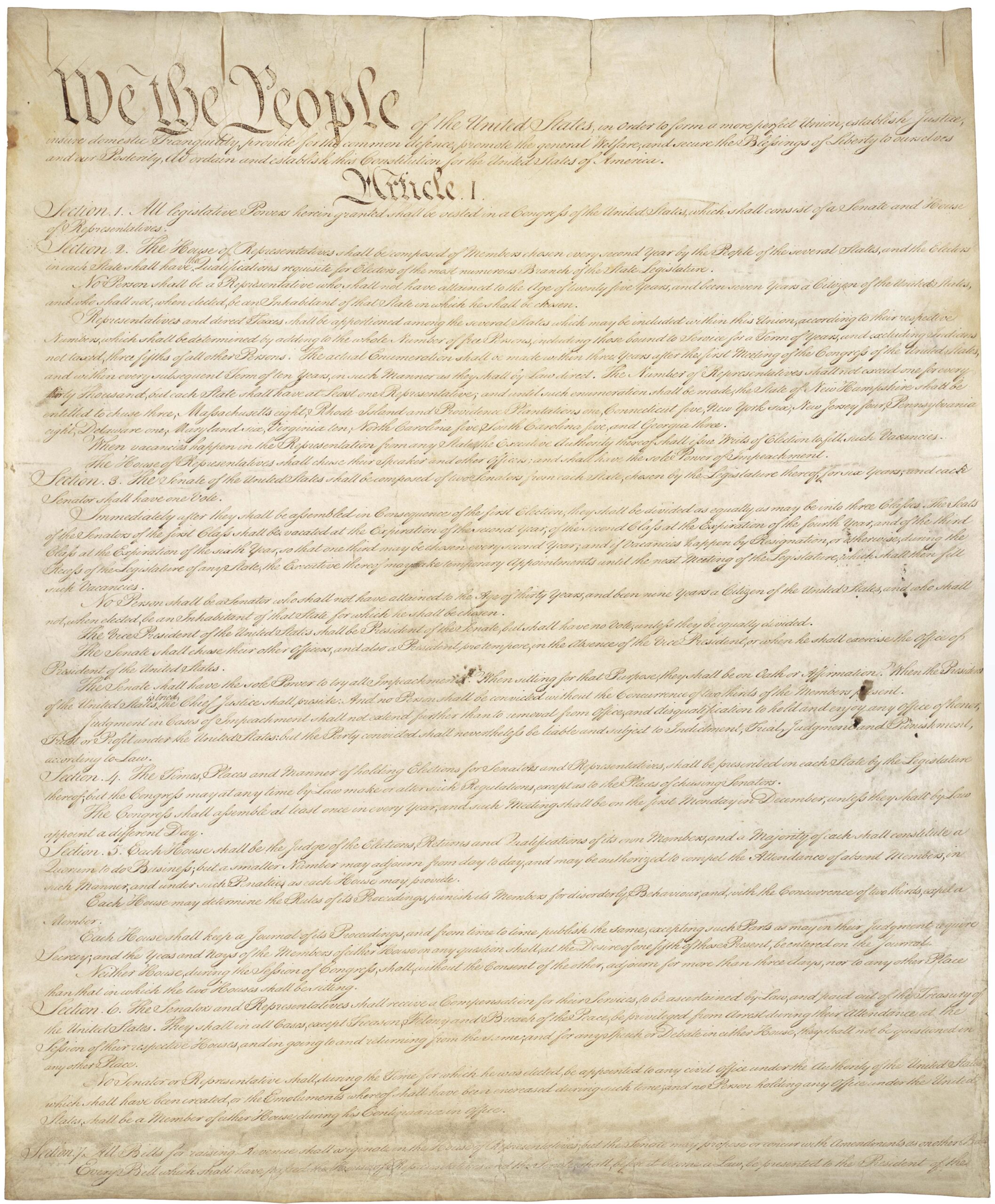
Contents · 12 chapters
- Government, the People, and Power
- Natural Rights and the Revolution
- The Need for Union
- Separation of Powers and Military Authority
- Property, Morality, and Religion
- Slavery and the Secession Crisis
- Civil War and Constitutional Change
- Progressivism and Founding Principles
- The New Deal and Federal Power
- Administrative Government
- Civil Rights and Modern Disputes
- Citizenship and Constitutional Renewal
Introduction
The Constitution gives the United States a framework for governing itself while limiting the power of those who govern. Its history helps us understand the responsibilities of public officials, the rights of individuals, and the continuing argument over how much authority government should exercise.
This article follows that argument from the founding through slavery and the Civil War, the Progressive Era, the New Deal, and modern administrative government. It approaches these subjects with an emphasis on liberty, constitutional limits, and the responsibilities of citizenship. Where it offers a judgment about good government, that judgment should be understood as an interpretation rather than an uncontested historical fact.
We must distinguish three kinds of change. An amendment changes the Constitution itself. A court decision interprets its application in a dispute. A statute or executive action changes government policy within the authority its supporters claim the Constitution allows. These processes interact, but they are not interchangeable. [1, 2, 3]
For readers of military history, this distinction has particular meaning. The statutory oaths for enlisted service members and commissioned officers require support and defense of the Constitution. Understanding that obligation requires more than respect for a historical document. It requires attention to the limits and duties that document establishes. [4, 5]
Chapter 1Government the People and Power
The Framers faced a lasting problem: how could people govern themselves without allowing one person, one institution, or one powerful faction to dominate everyone else? Their answer combined representative institutions with divided authority.
Alexander Hamilton discussed improvements in republican government in Federalist No. 9. These included representation, an independent judiciary, and arrangements for checking political power. James Madison developed the problem of faction in Federalist No. 10. These essays defended ratification; they were arguments for the proposed Constitution, not part of its binding text. [6]
Madison used faction to mean a group, whether a minority or a majority, whose shared interests or passions threatened other citizens' rights or the community's lasting interests. He did not claim that factions were usually minorities or that ordinary political disagreement was itself illegitimate. Because people differ in opinions, abilities, and property, he considered faction unavoidable in a free society. [6]
Eliminating liberty would destroy what government should protect. Making everyone think alike would be impossible. Madison therefore focused on controlling faction's effects. Representation could improve deliberation, while a large republic with many interests could make oppressive combinations more difficult to organize. He also acknowledged that representatives might betray the public trust. Representation was a safeguard, not a guarantee. [6]
Federalist No. 51 explained why institutions must check one another. Madison wrote, “If men were angels, no government would be necessary.” The same human weaknesses that make government necessary also make limits on government necessary. Federalist No. 55 nevertheless recognized that republican government depends on some capacity for virtue and public trust. [7]
The practical lesson remains useful. Elections matter, but a winning vote does not settle whether every resulting policy respects constitutional rights. Neither should constitutional limits become an excuse for ignoring lawful elections. Responsible self-government requires both public consent and restraints on the exercise of power.
Chapter 2Natural Rights and the American Revolution
The American Revolution drew on ideas that long predated the colonial protests of the 1760s. Natural-rights doctrine did not begin in that decade. John Locke's late-seventeenth-century writings, among other intellectual traditions, discussed natural equality, consent, and government's responsibility to protect life, liberty, and property. [8]
Colonial resistance gave these ideas an immediate political setting. The dispute involved taxation, representation, imperial authority, and the rights colonists believed they possessed. It cannot be reduced to a single request for seats in Parliament that Britain simply refused. The Declaration of Independence eventually presented a much wider indictment of British rule. [9]
Virginia's Declaration of Rights, adopted June 12, 1776, stated that people possess inherent rights and that public power derives from the people. It also connected free government with justice, moderation, and civic virtue. These ideas influenced other founding documents. [10]
The Declaration of Independence, adopted July 4, 1776, placed natural rights and consent at the center of the American case for independence. It asserted equality and the existence of rights that government should secure. It also maintained that a people could replace a government destructive of those purposes, while warning against doing so for light or temporary reasons. [9]
The founding generation did not apply these principles equally. Enslaved people were denied freedom, and the political community excluded many people from equal participation. The contradiction between universal claims and actual practice became a central issue in later American history.
The Declaration announced independence and explained its justification. It did not create the federal institutions established by the Constitution eleven years later. Reading the documents together helps us understand both the nation's stated purposes and the machinery designed to pursue them. [1, 9]
Chapter 3Majority Tyranny and the Need for Union
The Articles of Confederation were adopted in 1777 and became effective in 1781. They established a national Congress while preserving extensive state authority. It is inaccurate to say the Confederation government had no responsibility for common defense: Congress possessed important powers over war, peace, and military affairs. Its difficulty was obtaining the money and cooperation needed to carry out those responsibilities. [11]
Congress could request funds from the states but lacked an independent taxing power. The Articles also lacked a separate national executive and the general federal court system later established under the Constitution. They provided procedures for certain disputes, so the old government should not be described as having no means at all to address interstate disagreements. [11]
These weaknesses worried advocates of a stronger union. State-level political conflict, financial difficulties, and disagreements over commerce raised questions about whether the existing system could protect rights and sustain national obligations. The Philadelphia convention met in 1787 and produced a new constitutional framework rather than a modest revision of the Articles. [12]
The convention also confronted disagreements among the states. Representation in the House would reflect population, while each state would have two senators. This compromise helped reconcile competing claims of large and small states, although it did not resolve every dispute about political equality. [50]
The Constitution was signed September 17, 1787. New Hampshire became the ninth ratifying state on June 21, 1788, satisfying Article VII's threshold for establishment among the ratifying states. The new federal government began operating in 1789. Signing, ratification, and the start of government were separate events. [12]
The new system sought enough national authority to govern effectively while distributing power to reduce opportunities for abuse. The tension between effectiveness and restraint was present at the beginning; it did not arise only in modern politics.
Chapter 4Consent Separation of Powers and Military Authority
Consent of the governed does not mean that every citizen approves every decision. In a constitutional republic, it means that public authority is organized through lawful institutions, elections, and procedures, with protections that remain binding when political majorities change.
The Constitution distributes federal legislative, executive, and judicial authority among Congress, the president, and the courts. It also creates overlapping checks, including the veto, Senate participation in appointments, and impeachment. The branches are distinct, but they are not completely isolated from one another. [1]
Federalism provides a further division between national and state authority. The Tenth Amendment reserves powers not delegated to the United States, nor prohibited to the states, to the states or the people. The Bill of Rights, the first ten amendments ratified December 15, 1791, also protects such liberties as speech, religious exercise, and security against unreasonable searches. [2]
Article V makes formal change possible. Amendments may be proposed by two-thirds of both houses of Congress or by a convention called on applications from two-thirds of state legislatures. Ratification requires three-fourths of the states, through legislatures or conventions as Congress specifies. The president does not sign a constitutional amendment into effect. [1]
Military authority illustrates how these arrangements work. Congress has powers to declare war, raise and support armies, provide and maintain a navy, and regulate the armed forces. The president is commander in chief. Neither provision makes the other institution irrelevant. [1]
The War Powers Resolution of 1973 attempted to address the introduction of American forces into hostilities through consultation, reporting, and termination requirements. Disagreements over its meaning continued. The 2011 Libya operation, for example, produced a dispute over presidential authority and the meaning of hostilities. The resolution was not a specific congressional authorization for that intervention. [13]
The service oaths connect military duty to this constitutional order. The enlisted oath also addresses obedience to presidential and superior officers' orders according to regulations and the Uniform Code of Military Justice. The officer's oath has different wording. They should not be presented as identical. Both place support and defense of the Constitution at the center of service. [4, 5]
Chapter 5Property Morality and Religious Liberty
Many founding-era writers connected liberty with protection of property and the habits needed for self-government. Virginia's Declaration of Rights discussed property, religious exercise, and civic virtue. These ideas help explain why education, character, and public responsibility recur in early American political writing. [10]
George Washington's 1796 Farewell Address treated religion and morality as important supports for political prosperity. That was Washington's argument about the conditions of republican government. It was not an amendment establishing a national religion or a complete statement of every Founder's religious views. [14]
The federal Constitution prohibits religious tests for federal office. The First Amendment protects religious exercise and forbids laws respecting an establishment of religion. These provisions establish legal restraints on government even when citizens disagree about religion's role in public life. [1, 2]
Property rights likewise operate within a legal framework. The Fifth Amendment protects against deprivation of property without due process and requires just compensation for a taking for public use. It does not promise that property will never be taxed or regulated. A particular restriction must be evaluated under the relevant constitutional provision and law. [2]
Slavery exposed a profound moral and political contradiction. Enslavers asserted property claims over people whose liberty and labor they controlled. Describing that situation simply as a conflict between equally valid natural rights obscures the denial of personhood and freedom at its center.
The founding generation was divided, and some prominent advocates of liberty were themselves enslavers. Their statements against slavery must be read alongside their actions and the constitutional concessions that protected the institution. Recognizing the founding principles does not require overlooking those failures. [15, 16]
Chapter 6Slavery and the Secession Crisis
The original Constitution avoided the words slave and slavery, but it contained provisions that accommodated and protected enslavement. Avoidance of a word did not eliminate the institution or its political influence. [1, 15]
The Three-Fifths Clause counted three-fifths of the enslaved population for apportioning representation and direct taxes. It was a political counting rule, not a grant of three-fifths of a person's rights. It increased slaveholding states' representation compared with counting only free people. Other provisions addressed the return of people escaping bondage and prevented Congress from prohibiting certain slave importation before 1808. [1, 50]
Madison's notes of the August 25, 1787, convention debate record his objection to acknowledging property in human beings. Frederick Douglass and Abraham Lincoln belonged to later generations; they took no part in drafting the Constitution. Their later arguments about its meaning must be distinguished from the decisions made at the convention. [15]
The Confederation Congress adopted the Northwest Ordinance on July 13, 1787, before the Constitution was signed or ratified. It prohibited slavery in the territory north of the Ohio River, subject to its fugitive provision, and established a process for territorial government and statehood. It was a territorial restriction, not nationwide abolition. [16]
The Supreme Court's 1857 Dred Scott decision denied federal citizenship, for the constitutional purposes at issue, to people of African descent whose ancestors had been brought to America and enslaved. The Court also rejected congressional authority to prohibit slavery in the territories through the Missouri Compromise. This was a judicial holding later repudiated by constitutional change, not an objective acknowledgment that racial exclusion was morally justified. [17]
As disputes over slavery's expansion intensified, the constitutional system became the arena for competing claims about property, citizenship, territory, and federal power. These disputes cannot be explained solely as wounded regional pride or abstract disagreement over states' rights.
Chapter 7Secession Civil War and Constitutional Change
The secession declarations themselves establish slavery's central importance. Mississippi explicitly tied its decision to the institution, and Texas defended a racial and slaveholding order. Complaints about Northern resistance to fugitive-slave laws were therefore complaints about slavery, not a separate subject unrelated to it. [18, 19]
Lincoln opposed unilateral secession. In his First Inaugural Address of March 4, 1861, he argued that a state could not lawfully leave the Union on its own authority. He also distinguished his opposition to slavery's expansion from a claim that he could immediately abolish it in states where it already existed. [20]
Lincoln's earlier Cooper Union Address criticized demands that opponents of slavery stop calling it wrong. His discussion of Senator Stephen Douglas's proposed sedition measures was part of that criticism. He was not recommending a law suppressing antislavery speech. [21]
The Union initially fought to preserve the country. Emancipation became an explicit Union war objective as the conflict progressed. Lincoln's final Emancipation Proclamation took effect January 1, 1863, as a wartime measure covering designated areas in rebellion. It did not abolish slavery throughout the United States, and its practical enforcement depended on Union success and the actions of enslaved people seeking freedom. [22]
Nationwide constitutional abolition came with the Thirteenth Amendment, ratified December 6, 1865. Its text prohibits slavery and involuntary servitude except as punishment for crime after conviction. The Fourteenth Amendment, ratified in 1868, established birthright and naturalized citizenship subject to its jurisdictional language, and imposed due-process and equal-protection requirements on the states. The Fifteenth Amendment, ratified in 1870, prohibited voting discrimination based on race, color, or previous servitude. [3, 23, 24]
In Texas v. White in 1869, the Supreme Court held that Texas's secession ordinance was legally ineffective. Its discussion recognized revolution or the consent of the states as distinct possibilities; it did not recognize an ordinary unilateral constitutional right to withdraw. [25]
Lincoln's Second Inaugural Address belongs to the closing months of the war, not to the Gettysburg Address. Its appeal to reconciliation did not erase its condemnation of slavery. We should distinguish the speeches and describe Lincoln's understanding of divine judgment as his expressed belief, rather than as a historical fact that scholarship can prove. [26]
Chapter 8Progressivism and Founding Principles
The Progressive Era brought arguments that older institutions and limits were inadequate for industrial society. Woodrow Wilson provides a clear example. In The New Freedom, published in 1913, he contrasted a mechanical understanding of constitutional checks with an organic understanding of government that adapts to changing conditions. This was a political analogy, not a scientific demonstration that constitutional limits had become obsolete. [27]
Wilson's argument raises an enduring question: should changes in society alter only government policy, or should they also alter how constitutional authority is understood? Readers who favor limited government may reasonably worry that flexible interpretation allows officials to expand power without obtaining an amendment. That concern is an interpretation of the risks, not proof that every progressive reform was unconstitutional.
Progressivism was not a single program shared identically by every reformer. Nor did change in this period occur only through courts or administrative agencies. The Sixteenth Amendment authorized federal income taxation without apportionment among the states. The Seventeenth Amendment established direct election of senators. Both were ratified in 1913 through the Constitution's amendment process. [3]
The Nineteenth Amendment, ratified August 18, 1920, prohibited denial or abridgment of voting rights on account of sex. It followed decades of organized advocacy and expanded constitutional protection for political participation, although other discriminatory barriers persisted. [28]
These examples show why constitutional history requires attention to method. An amendment, a statute, an administrative rule, and a judicial interpretation are different forms of change. We can question the merits of a reform while accurately identifying the authority and procedure used to adopt it.
Chapter 9The New Deal and Federal Power
Franklin D. Roosevelt took office in 1933 during the Great Depression. The New Deal expanded federal efforts in relief, employment, economic recovery, financial regulation, and social insurance. Congress enacted major programs, while agencies administered them and courts reviewed constitutional challenges. [29]
The Social Security Act of 1935 created a federal old-age benefits system and provisions addressing unemployment and assistance to vulnerable groups. It enlarged the federal role in economic security and required substantial administrative machinery. The policy reflected legislation enacted by Congress, not simply a presidential order. [30]
The Supreme Court did not accept every expansion of authority. In A. L. A. Schechter Poultry Corp. v. United States in 1935, it invalidated the challenged industrial code, finding an unconstitutional delegation of legislative authority and limits on Congress's commerce power. The case demonstrated that economic emergency did not automatically remove constitutional restrictions. [31]
In 1937, the Court upheld application of the National Labor Relations Act in NLRB v. Jones & Laughlin Steel Corp. It recognized congressional power over activities closely and substantially related to interstate commerce. In Helvering v. Davis that year, it upheld the challenged Social Security tax and old-age benefits arrangement. These decisions helped establish broader room for federal economic legislation. [32, 33]
Roosevelt also proposed adding justices when sitting justices did not retire within six months of reaching seventy. The court-expansion proposal provoked strong resistance and did not become law. It is too simple to treat the subsequent judicial developments as proof that the president controlled the Court or that a single political threat explains every justice's reasoning. [29]
The New Deal changed expectations about federal responsibility. Whether particular changes strengthened the country or weakened constitutional restraint remains a subject of historical and political debate. Evaluating that question requires examining specific programs and decisions rather than declaring the whole constitutional order abolished.
Chapter 10Administrative Government and Constitutional Limits
Administrative agencies implement laws, make rules within delegated authority, and in some settings conduct adjudications. Their influence raises legitimate questions about accountability, concentrated power, technical expertise, and the cost of challenging government action. Those concerns deserve scrutiny. They do not justify saying that laws no longer exist or that agencies possess unlimited legal authority.
The Administrative Procedure Act, enacted in 1946, provides an important framework. Section 553 generally requires notice and an opportunity for public comment for covered legislative rulemaking, with specified exceptions. Interpretive rules and policy statements are treated differently. Identifying an exception is not the same as proving that every use of it is lawful. [34]
Sections 702 and 704 provide avenues for judicial review, subject to applicable limits, including requirements concerning reviewable or final agency action and other adequate remedies. Section 706 directs courts to decide legal questions and to set aside qualifying unlawful action, including action exceeding statutory authority or violating constitutional rights. Access can involve procedural hurdles, expense, and delay, but it does not generally depend on an agency granting personal permission to sue. [35, 36, 37]
Several cases illustrate the distinction between agency claims and the courts' conclusions. In Marshall v. Barlow's, Inc. in 1978, the Supreme Court held that the challenged warrantless OSHA inspection violated the Fourth Amendment. Commercial premises receive constitutional protection. Administrative warrants may use standards different from warrants investigating a particular crime, and exceptions may apply, including in closely regulated industries. A general claim that every business is open to inspection without a warrant is incorrect. [38]
In Sackett v. EPA in 2012, the Court allowed the property owners to seek Administrative Procedure Act review of an EPA compliance order. Their difficulty obtaining an earlier hearing was a real issue in the litigation; it should not be presented as a continuing universal rule that the EPA alone controls access to federal court. [39]
The Eighth Amendment's protection against excessive fines is also relevant beyond ordinary criminal sentencing. Austin v. United States in 1993 held that the civil forfeitures at issue were subject to that protection because they served, at least in part, as punishment. Whether a particular assessment is excessive requires analysis; it is inaccurate to say punitive civil sanctions are categorically exempt. [40]
Criminal convictions require proof beyond a reasonable doubt of every fact necessary to constitute the charged crime. Civil and administrative proceedings may use different standards, depending on their governing law. That difference alone does not establish that a proceeding is unconstitutional or that the government has no burden of proof. In re Winship in 1970 affirmed the constitutional importance of the criminal standard. [41]
Two decisions in 2024 further illustrate continuing constitutional and statutory limits. Loper Bright Enterprises v. Raimondo overruled Chevron's requirement of deference to reasonable agency interpretations of ambiguous statutes. Courts must exercise independent judgment on legal meaning while respecting lawful delegations of discretion. The decision did not abolish agencies or invalidate all existing regulations. [42]
In SEC v. Jarkesy, the Court held that the Seventh Amendment entitled defendants to a jury trial when the SEC sought civil penalties for securities fraud in the circumstances before it. The holding should not be expanded into a claim that every administrative proceeding requires a jury. [43]
My concern remains the distance that can develop between citizens and officials who exercise consequential authority. The strongest criticism identifies the statute, decision, procedure, and injury involved. It asks whether the safeguards work in practice and whether Congress should improve them. Calling the entire system an oligarchy without that analysis substitutes a political conclusion for the evidence needed to support it.
Chapter 11Civil Rights and Modern Political Disputes
The political changes associated with the 1960s included distinct movements and legislative programs. Civil rights, student activism, changes in family life, immigration reform, and later disputes about identity should not be treated as one coordinated project with a single motive.
The Civil Rights Act of 1964 prohibited major forms of discrimination in public accommodations, employment, and federally assisted programs. The Voting Rights Act of 1965 addressed discriminatory barriers that had prevented many Black citizens from exercising rights the Fifteenth Amendment promised. These were enacted statutes aimed at enforcing civil and political rights, not simply bureaucratic attempts to replace elections. [44, 45]
The Immigration and Nationality Act of 1965 ended the national-origins quota system. Its consequences can be debated, but it was legislation passed by Congress and signed by the president. Legal immigration policy and failures to enforce immigration law are different subjects and require different evidence. [46]
Modern procedural controversies also require precision. The Senate passed the principal Affordable Care Act bill by 60–39 on December 24, 2009. That measure became law on March 23, 2010. A separate reconciliation law, enacted March 30, changed parts of the health-care legislation. Saying the entire Affordable Care Act was passed through reconciliation misstates the sequence. [47, 48]
Treaties and executive agreements are likewise distinct. The Constitution's treaty process involves presidential action and the advice and consent of two-thirds of senators present. Executive agreements have other legal foundations and are not automatically interchangeable with treaties. Neither label creates authority to override the Constitution. [49]
We can debate redistribution, regulation, equal treatment, and the proper reach of federal authority without assigning the same beliefs to everyone on the political left or right. Historical analysis is stronger when it identifies a specific proposal, its supporters' stated reasoning, and the constitutional objection raised against it.
The issue running through these disputes is accountability: who makes the decision, what authority supports it, whose rights are affected, and what means exist to challenge or change it? Those questions apply to leaders of every party.
Chapter 12Citizenship and Constitutional Renewal
Constitutional government depends on people willing to use its institutions responsibly. Written limits matter, but they cannot relieve citizens and officials of judgment, honesty, and restraint. Madison's discussion of institutional checks and public virtue remains a useful starting point. [7]
I favor a return to careful attention to constitutional boundaries, equal treatment under law, and the duties of citizenship. That does not mean pretending the founding settlement was complete or free of injustice. The abolition of slavery and later protections for citizenship and voting show why constitutional renewal has sometimes required profound change. [23, 24, 28]
We should begin with the actual text and ask what has been amended, what a court has decided, and what a political commentator is arguing. A quotation should be read in context. A charge of unconstitutional conduct should identify the provision and action involved. Respect for expertise should not excuse unaccountable power, and distrust of officials should not excuse inaccurate claims.
Voting is part of this responsibility. So are reviewing candidates' records, contacting representatives, participating in lawful public debate, and insisting that officials explain the authority for their actions. Constitutional limits should matter when our preferred party holds power as much as when it does not.
For a military-history audience, the service oath gives these principles a direct connection to duty. The Constitution establishes the public order that service members undertake to support and defend. Studying its history helps us understand both the country they serve and the responsibilities that remain with all of us. [4, 5]

Walking in the Garden
Explore Jeff Daley’s account of long-range reconnaissance in Vietnam’s Central Highlands.
Explore the memoirSource
Numbered references support the surrounding historical and legal claims. Political judgments remain interpretations. Sources reviewed November 5, 2026. Send a historical correction.
- National Archives. The Constitution of the United States A Transcription. Articles I through VII, especially Articles I to III, V, VI, and VII. Read source · Related record 1Return to passage: 1 · 2 · 3 · 4 · 5 · 6 · 7 · 8
- National Archives. The Bill of Rights A Transcription. Amendments I, IV, V, VIII, and X; ratified December 15, 1791. Read sourceReturn to passage: 1 · 2 · 3 · 4
- National Archives. The Constitution Amendments 11 to 27. Especially Amendments XV, XVI, and XVII and their ratification dates. Read sourceReturn to passage: 1 · 2 · 3
- United States Code. 10 U.S.C. section 502. Enlistment oath. Read sourceReturn to passage: 1 · 2 · 3
- United States Code. 5 U.S.C. section 3331. Oath of office, including the uniformed services. Read sourceReturn to passage: 1 · 2 · 3
- Alexander Hamilton and James Madison. Federalist Nos. 9 and 10, 1787. Primary texts at Yale Law School's Avalon Project. See also the Library of Congress introduction explaining the ratification campaign. Read source · Related record 1 · Related record 2Return to passage: 1 · 2 · 3
- James Madison. Federalist Nos. 51 and 55, 1788. Library of Congress, Federalist Nos. 51 to 60. No. 51 addresses institutional checks; No. 55 discusses the qualities presupposed by republican government. Read sourceReturn to passage: 1 · 2
- John Locke. Second Treatise of Government, sections 4, 6, and 131, first published in 1689 with a 1690 title-page date. Primary excerpts hosted by the National Constitution Center and University of Chicago Press. Read source · Related record 1Return to passage: 1
- National Archives. Declaration of Independence A Transcription. Adopted July 4, 1776; opening statement of principles and listed grievances. Read sourceReturn to passage: 1 · 2 · 3
- National Archives. The Virginia Declaration of Rights. June 12, 1776; especially sections 1, 2, 5, 6, 13, 15, and 16. Read sourceReturn to passage: 1 · 2
- National Archives. Articles of Confederation, 1777, effective 1781. See the transcript, especially Articles VIII, IX, and XIII, for finances, national powers, dispute procedures, and amendment requirements. Read sourceReturn to passage: 1 · 2
- National Archives. A More Perfect Union The Creation of the U.S. Constitution. Convention, representation compromise, ratification, and transition to the new government. Read source · Related record 1Return to passage: 1 · 2
- Congressional Research Service. The War Powers Resolution Concepts and Practice, R42699. See the discussion of the 2011 Libya operation, its legal rationale, and the dispute over hostilities. Read sourceReturn to passage: 1
- George Washington. Farewell Address, September 19, 1796. United States Senate edition; discussion of religion, morality, and republican government. Read sourceReturn to passage: 1
- James Madison. Notes of Debates in the Federal Convention, August 25, 1787. Primary text reproduced by Encyclopedia Virginia; discussion of slave importation and property in people. Read sourceReturn to passage: 1 · 2 · 3
- National Archives. Northwest Ordinance, July 13, 1787. See Article VI of the transcript for the slavery prohibition and fugitive provision. Read sourceReturn to passage: 1 · 2
- National Archives. Dred Scott v. Sandford, March 6, 1857. Judgment and opinion transcript concerning citizenship, federal jurisdiction, and slavery in the territories. Read sourceReturn to passage: 1
- Mississippi secession convention. Declaration of the Immediate Causes of Secession, 1861. Primary text at Yale Law School's Avalon Project. Read sourceReturn to passage: 1
- Texas secession convention. Declaration of Causes, February 2, 1861. Primary text at the Texas State Library and Archives Commission. Read sourceReturn to passage: 1
- Abraham Lincoln. First Inaugural Address, March 4, 1861. Primary text at the National Park Service; Union, slavery, and constitutional authority. Read sourceReturn to passage: 1
- Abraham Lincoln. Cooper Union Address, February 27, 1860. National Park Service primary text; see the closing criticism of demands to suppress antislavery speech. Read sourceReturn to passage: 1
- National Archives. Emancipation Proclamation, January 1, 1863. Primary text and explanation of its geographic and military limits. Read sourceReturn to passage: 1
- National Archives. Thirteenth Amendment Abolition of Slavery. Ratified December 6, 1865; text includes the exception for punishment after conviction. Read sourceReturn to passage: 1 · 2
- National Archives. Fourteenth Amendment Civil Rights. Ratified July 9, 1868; citizenship, due process, and equal protection. Read sourceReturn to passage: 1 · 2
- Supreme Court of the United States. Texas v. White, 74 U.S. 700 (1869), especially pages 725 to 726. Opinion reproduced by Cornell Legal Information Institute. Read sourceReturn to passage: 1
- Abraham Lincoln. Second Inaugural Address, March 4, 1865. Primary text at the National Park Service. Read sourceReturn to passage: 1
- Woodrow Wilson. The New Freedom, 1913, excerpt on constitutional development and the Darwinian analogy. Primary text at the National Constitution Center. Read sourceReturn to passage: 1
- National Archives. Nineteenth Amendment Women's Right to Vote. Ratified August 18, 1920. Read sourceReturn to passage: 1 · 2
- Library of Congress. The New Deal, classroom materials and chronology. Federal Judicial Center. FDR's Court Packing Plan and Judicial Independence and the Federal Courts, section 6, for the plan's retirement threshold and competing explanations of the Court's decisions. Read source · Related record 1 · Related record 2Return to passage: 1 · 2
- National Archives. Social Security Act, August 14, 1935. Signed act and explanation of its programs. Read sourceReturn to passage: 1
- Supreme Court of the United States. A. L. A. Schechter Poultry Corp. v. United States, 295 U.S. 495 (1935), especially pages 541 to 542 and 548 to 551. Court opinion at Cornell Legal Information Institute. Read sourceReturn to passage: 1
- Supreme Court of the United States. NLRB v. Jones & Laughlin Steel Corp., 301 U.S. 1 (1937), especially pages 36 to 43. Court opinion at Cornell Legal Information Institute. Read sourceReturn to passage: 1
- Supreme Court of the United States. Helvering v. Davis, 301 U.S. 619 (1937). Court opinion at Cornell Legal Information Institute. Read sourceReturn to passage: 1
- United States Code. 5 U.S.C. section 553. Notice, public comment, rulemaking procedures, and exceptions. Read sourceReturn to passage: 1
- United States Code. 5 U.S.C. section 702. Right of judicial review and qualifications. Read sourceReturn to passage: 1
- United States Code. 5 U.S.C. section 704. Reviewable agency action, finality, and adequate-remedy requirements. Read sourceReturn to passage: 1
- United States Code. 5 U.S.C. section 706. Scope of review, legal questions, and grounds for setting aside agency action. Read sourceReturn to passage: 1
- Supreme Court of the United States. Marshall v. Barlow's, Inc., 436 U.S. 307 (1978), especially pages 311 to 325. Court opinion at Cornell Legal Information Institute. Read sourceReturn to passage: 1
- Supreme Court of the United States. Sackett v. EPA, 566 U.S. 120 (2012). This is the judicial-review decision, not the separate 2023 wetlands decision. Court opinion at Cornell Legal Information Institute. Read sourceReturn to passage: 1
- Supreme Court of the United States. Austin v. United States, 509 U.S. 602 (1993), especially pages 609 to 622. Justice Blackmun's Court opinion at Cornell Legal Information Institute. Read sourceReturn to passage: 1
- Supreme Court of the United States. In re Winship, 397 U.S. 358 (1970), especially page 364. Court opinion at Cornell Legal Information Institute. Read sourceReturn to passage: 1
- Supreme Court of the United States. Loper Bright Enterprises v. Raimondo, 603 U.S. 369 (2024), decided June 28, 2024. Chief Justice Roberts's Court opinion, especially Parts IV and V, at Cornell Legal Information Institute. Read sourceReturn to passage: 1
- Supreme Court of the United States. SEC v. Jarkesy, 603 U.S. 109 (2024), decided June 27, 2024. Chief Justice Roberts's Court opinion at Cornell Legal Information Institute. Read sourceReturn to passage: 1
- National Archives. Civil Rights Act, July 2, 1964. Signed statute and historical explanation. Read sourceReturn to passage: 1
- National Archives. Voting Rights Act, August 6, 1965. Signed statute and historical explanation. Read sourceReturn to passage: 1
- United States House of Representatives, History Art and Archives. Immigration and Nationality Act of 1965, October 3, 1965. See also the signed act at the National Archives. Read source · Related record 1Return to passage: 1
- United States Senate. Roll Call Vote 396, December 24, 2009, H.R. 3590 as amended. Vote 60 to 39. Congressional Record reproduction at GovInfo included as an alternate primary record. Read source · Related record 1Return to passage: 1
- Congressional Research Service. Legislative Actions to Modify the Affordable Care Act in the 111th to 115th Congresses, R45244, June 26, 2018. CRS report reproduced by EveryCRSReport; introduction distinguishes P.L. 111-148 from P.L. 111-152. Read sourceReturn to passage: 1
- United States Senate. About Treaties. For constitutional supremacy over agreements, see Reid v. Covert, 354 U.S. 1 (1957), especially Justice Hugo Black's plurality discussion at pages 16 to 18; separate opinions are identified in the linked text. Read source · Related record 1Return to passage: 1
- Library of Congress. Creating the United States Constitution Representation. Primary Committee of Style text and explanation of the representation compromise. Read sourceReturn to passage: 1 · 2