
 Jeff Daley Books
Special Forces Twelve-Man Teams Explained
Different specialties, shared responsibilities, and the ability to work together give the A-Team its strength.
A Special Forces team brings a range of military skills into one small organization. The familiar twelve-man Operational Detachment-Alpha, or ODA, is also known as an A-Team. Its strength comes from combining specialists who can work together, teach others, and share responsibilities when circumstances demand it.
My original article described the team’s composition alongside the expansion of Special Forces during the Kennedy years. This chapter preserves those subjects and the original Vietnam photograph, while separating the modern roster from the organization used in earlier decades.
How the A-Team developed
The twelve-man organization was not fixed from the beginning. Army historical research traces changes from the OSS Operational Group section to early Special Forces detachments. Team strength varied with successive organizational tables, ranging from twelve to fifteen soldiers.
A September 1963 table reduced the detachment to twelve. Later revisions changed its strength again. Beginning in 1984, experienced warrant officers replaced lieutenants as the second officer on the team. The familiar modern roster therefore should not be projected unchanged back into the 1950s.1
The central idea endured: a small team combined leadership with weapons, engineering, medical, and communications skills. The exact positions, ranks, and authorized strength changed.
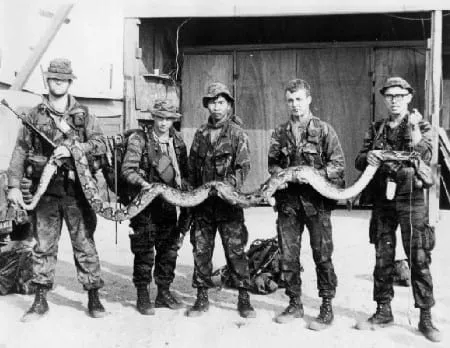
Who does what on a twelve-man ODA
The standard modern roster below summarizes the positions described by Army recruiting and historical sources. It describes an authorized organization; it does not imply that every deployed team always has every position filled.12
| Position | Number | Specialty |
|---|---|---|
| Detachment commander | 1 | 18A officer |
| Assistant detachment commander | 1 | 180A warrant officer |
| Operations sergeant or team sergeant | 1 | 18Z |
| Assistant operations and intelligence sergeant | 1 | 18F |
| Weapons sergeants | 2 | 18B |
| Engineer sergeants | 2 | 18C |
| Medical sergeants | 2 | 18D |
| Communications sergeants | 2 | 18E |
Cross-training and split teams
The original article emphasized cross-training. A soldier’s principal specialty gives the team depth; familiarity with other specialties provides resilience. Two specialists in each of the four main technical fields also create opportunities for mentoring and continuity.
The organization can support two six-man elements when the mission and available personnel permit. That flexibility does not make either half identical to the full team. Responsibilities and available expertise must still match the assignment.
Language preparation is another part of working with partner forces. Technical knowledge has limited value if an adviser cannot communicate it. Language and regional understanding help turn individual competence into useful instruction.
Growth under President Kennedy
At the beginning of the 1960s, the 1st, 7th, and 10th Special Forces Groups formed the core of the active force. President John F. Kennedy’s interest in unconventional warfare and counterinsurgency helped give Special Forces greater visibility and support.
The 5th Group was activated in September 1961. Expansion continued in 1963 with the 8th Group in April, the 6th in May, and the 3rd in December.3 Growth created a continuing demand for trained soldiers and teams able to work with foreign forces.
Kennedy’s association with the green beret also helped make it a recognized symbol of Special Forces.4 Chapter 4 will follow the story behind that symbol.
The Thailand connection
The original article also discussed the 46th Special Forces Company. Its chronology needs a distinction: Company D, 1st Special Forces Group, was formed in April 1966 and deployed to Thailand that October. The independent 46th Special Forces Company was activated in April 1967, replacing Company D.
Its work with the Royal Thai Army included training and the development of Thai Special Forces capability. The relationship continued beyond November 1967; the 46th Company remained active until the 1972 reorganization.5
Specialization serves the mission
ODAs may develop additional capabilities suited to their assignments, including military freefall, combat diving, or mountain operations. Those capabilities supplement the team’s core specialties. They do not replace the requirement to work effectively with one another and with partner forces.
The reason for the team’s composition is practical. A compact organization must bring enough skills to accomplish its task while retaining the flexibility to adapt. The roster provides the structure; training and trust make it work.

Walking in the Garden
Follow the history into a firsthand account of long-range reconnaissance in Vietnam’s Central Highlands, written by veteran Jeff Daley.
Explore the memoir Find a booksellerNext: Chapter 4 — The Story Behind the Green Beret
Source
References for Chapter 3. Historical tables of organization are distinguished from the standard modern roster.
- USASOC History Office, The Evolution of the Special Forces Operational Detachment-Alpha.
- U.S. Army Special Operations Recruiting, Special Forces team positions; U.S. Army, Army Directive 2026-07, occupational specialty designations.
- USASOC History Office, Veritas, Volume 3, Number 1, “SF Setup and Growth.”
- U.S. Army, The Green Berets and Kennedy: Two Legacies Forever United.
- USASOC History Office, Building Generational Relationships, history of Company D and the 46th Special Forces Company in Thailand.
- Original article and photograph: Jeff Daley, Special Forces Part 3 — Twelve Man Teams, originally published July 8, 2015.